

The goal is to record most books written or edited by the Department of History faculty, instructors, and students.There is a WMU Authors section in Waldo Library, where most of these books can be found in print.
With a few exceptions, we do not have the rights to put the full text of the book online, so there will be a link to a place where you can purchase the book.
If you are a faculty member and have a book you would like to include in the WMU book list, please contact [email protected]/














-
Historical Dictionary of Medieval China
Victor Cunrui Xiong
The crucial period of Chinese history, 220-960, falls naturally into contrasting phases. The first phase, also known as that of "early medieval China," is an age of political decentralization. Following the breakup of the Han empire, China was plunged into civil war and fragmentation and stayed divided for nearly four centuries. The second phase started in 589, during the Sui dynasty, when China was once again brought under a single government. Under the Sui, the bureaucracy was revitalized, the military strengthened, and the taxation system reformed. The fall of the Sui in 618 gave way to the even stronger Tang dynasty, which represents an apogee of traditional Chinese civilization. Inheriting all the great institutions developed under the Sui, the Tang made great achievements in poetry, painting, music, and architecture. The An Lushan rebellion, which also took place during Tang rule, brought about far-reaching changes in the socioeconomic, political, and military arenas. What transpired in the second half of the Tang and the ensuing Five Dynasties provided the foundation for the next age of late imperial China. The Historical Dictionary of Medieval China fills an urgent need for a standard reference tailored to the interest of Western academics and readers. The history of medieval China is related through the book's introductory essay, maps, a table of Dynastic Periods, a bibliography, and hundreds of cross-referenced dictionary entries on key people, historical geography, arts, institutions, events, and other important terms.
-
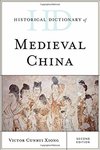
Historical Dictionary of Medieval China
Victor Cunrui Xiong
The crucial period of Chinese history, 168-979, falls naturally into contrasting phases. The first phase, also known as that of 'early medieval China,' is an age of political decentralization. Following the breakup of the Han empire, China was plunged into civil war and fragmentation and stayed divided for nearly four centuries. The second phase started in 589, during the Sui dynasty, when China was once again brought under a single government. Under the Sui, the bureaucracy was revitalized, the military strengthened, and the taxation system reformed. The fall of the Sui in 618 gave way to the even stronger Tang dynasty, which represents an apogee of traditional Chinese civilization. Inheriting all the great institutions developed under the Sui, the Tang made great achievements in poetry, painting, music, and architecture. The An Lushan rebellion, which also took place during Tang rule, brought about far-reaching changes in the socioeconomic, political, and military arenas. What transpired in the second half of the Tang and the ensuing Five Dynasties provided the foundation for the next age of late imperial China.
This second edition of Historical Dictionary of Medieval China contains a chronology, an introduction, and an extensive bibliography. The dictionary section has over 1000 cross-referenced entries on historical figure. It expands on existing thematic entries, and adds a number of new ones with substantial content, including those on nobility, art, architecture, archaeology, economy, agriculture, money, population, cities, literature, historiography, military, religion, Persia, India, Japan, Korea, Arabs, and Byzantium, among others. This book is an excellent access point for students, researchers, and anyone wanting to know more about medieval China.
-
Routledge handbook of Imperial Chinese history
Victor Cunrui Xiong and Kenneth J. Hammond
The resurgence of modern China has generated much interest, not only in the country¿s present day activities, but also in its long history. As the only uninterrupted ancient civilization still alive today, the study of China¿s past promises to offer invaluable insights into understanding contemporary China. Providing coverage of the entire Imperial Era (221 BCE - 1912 CE) this handbook takes a chronological approach. It includes comprehensive analysis of all major periods, from the powerful Han empire which rivalled Rome and the crucial transformative period of the Five Dynasties, to the prosperous Ming era and the later dominance of the non-Han peoples. With contributions from a team of international authors, key themes include: Political events and leadership Religion and philosophy Cultural and literary achievements Legal, economic and military institutions This book transcends the traditional boundaries of historiography, giving special attention to the role of archaeology. As such, the Routledge Handbook of Imperial Chinese History is an indispensable reference work for students and scholars of Chinese, Asian, and World History.
-
A Thorough Exploration in Historiography: Shitong
Victor Cunrui Xiong and Michael Nylan
In the early eighth century, frustrated with the authorities but still hoping to gain immortality through his future oeuvre, the Tang court historian Liu Zhiji set out to write Shitong, in which he would rigorously explore the tradition of historical writing in China. Liu scrutinized hundreds of texts from antiquity to the early Tang dynasty (618?907) and evaluated their authors according to what he deemed the three essential qualities for historians: talent, knowledge, and insight. Shitong is now generally considered the greatest work of traditional Chinese historiography. It preserves precious information on a host of lost ancient and medieval titles while advancing a critical view on history writing. This first translation of the work into a Western language provides textual criticism and annotation for the historical figures, events, and allusions that are crucial to appreciating the work, making it a must-read for students of historiography East and West.
-
From Cultures of War to Cultures of Peace: War and Peace Museums in Japan, China, and South Korea
Takashi Yoshida
"Professor Yoshida examines historical analyses of war and peace museums from the late 19th century to the present and traces the historical development of a pacifist discourse in postwar Japan that centered on Japan's war crimes and responsibility"--Page 4 of cover.
-
The Making of the "Rape of Nanking": History and Memory in Japan, China, and the United States
Takashi Yoshida
On December 13, 1937, the Japanese army attacked and captured the Chinese capital city of Nanjing, planting the rising-sun flag atop the city's outer walls. What occurred in the ensuing weeks and months has been the source of a tempestuous debate ever since. It is well known that the Japanese military committed wholesale atrocities after the fall of the city, massacring large numbers of Chinese during the both the Battle of Nanjing and in its aftermath. Yet the exact details of the war crimes--how many people were killed during the battle? How manyafter? How many women were raped? Were prisoners executed? How unspeakable were the acts committed?--are the source of controversy among Japanese, Chinese, and American historians to this day. In The Making of the "Rape of Nanking" Takashi Yoshida examines how views of the Nanjing Massacre have evolved in history writing and public memory in Japan, China, and the United States. For these nations, the question of how to treat the legacy of Nanjing--whether to deplore it, sanitize it,rationalize it, or even ignore it--has aroused passions revolving around ethics, nationality, and historical identity. Drawing on a rich analysis of Chinese, Japanese, and American history textbooks and newspapers, Yoshida traces the evolving--and often conflicting--understandings of the NanjingMassacre, revealing how changing social and political environments have influenced the debate. Yoshida suggests that, from the 1970s on, the dispute over Nanjing has become more lively, more globalized, and immeasurably more intense, due in part to Japanese revisionist history and a renewed emphasison patriotic education in China. While today it is easy to assume that the Nanjing Massacre has always been viewed as an emblem of Japan's wartime aggression in China, the image of the "Rape of Nanking" is a much more recent icon in public consciousness. Takashi Yoshida analyzes the process by which the Nanjing Massacre has becomean international symbol, and provides a fair and respectful treatment of the politically charged and controversial debate